dimanche 22 février 2015

The ‘hobbit boy’ with feet so big he can barely walk will soon be able to play again after groundbreaking treatment


This is the unfortunate teenager whose feet have grown too large to fit any shoes.
Teenager Xiao Meng, who has been nicknamed Hobbit boy by schoolmates, was born with congenital neurofibromatosis – a genetic condition which causes the feet to swell abnormally.
His family were too poor to pay for treatment and his feet have grown bigger and bigger with age.

Xiao Meng was born with congenital neurofibromatosis a genetic condition which causes the feet to swell abnormally. Xiao Meng’s father massages his feet at Shanghai Children’s Hospital.

A doctor measures Xiao Meng's feet at hospital. His family were too poor to pay for treatment and his feet have grown bigger and bigger with age 

A doctor measures Xiao Meng’s feet at hospital. His family were too poor to pay for treatment and his feet have grown bigger and bigger with age

His feet have grown too large to fit any shoes because of the growths caused by the condition 

His feet have grown too large to fit any shoes because of the growths caused by the condition
The 14-year-old will have his feet treated at Shanghai Children’s Hospital, China.
The hospital has pledged to give him free care, following a campaign launched by his school teachers and supported by the Chinese media.
Doctors first plan to cut away the excess growths from his feet before allowing half a year for recovery. 

The scale of the 14 year old's feet can be seen when placed next to a hand 

The scale of the 14 year old’s feet can be seen when placed next to a hand

He is set to undergo treatment which will mean he will one day have much smaller feet. But the teenager will need to learn to walk again 
He is set to undergo treatment which will mean he will one day have much smaller feet. But the teenager will need to learn to walk again


After a long campaign by Chinese media and teachers at his school he will now have the life changing surgery 

After a long campaign by Chinese media and teachers at his school he will now have the life changing surgery
The next stage will be for Xiao to learn how to use his newly trimmed feet.
‘We’re an ordinary family and it breaks my heart to see him suffer but we have no money for medicine,’ explained dad Meng Zhaoguang.
The youngster added: ‘I like school but it hurts to walk and I can’t go quickly or join in many games. Children sometimes call me names but they don’t mean to be cruel.’
Now he is facing a new life after well-wishers donated thousands of pounds for medical fees after he appeared in local media.
Medics at Shanghai’s Children’s Hospital in eastern China are hopeful for the young man’s outcome.

Doctor Tang Yujin said: ‘We can treat the condition and when that is stable we plan to reduce the size of his feet so they look and feel more normal.’

5 Unfortunately Shaped Skyscrapers


Chinese news agency Xinhua reports of a new building in Suzhou that is nearing completion. The 74-story Gate to the East was designed to look like an arch, but unfortunately, in the eyes of many it appears as a giant pair of trousers.
The developer of the landmark building has recently come under much criticism for the unconventional look. One user on China’s blogging website Weibo reportedly said, “This should be called the Pants of the East, not the Gate of the East”.
The 278-meter-high Gate was developed by the private firm Suzhou Chianing Real Estate Co., Ltd to accommodate offices, hotels, malls and apartments. The eight-year construction process is expected to be completed in 2012, costing a total of $700 million.

Xu Kang, the company’s vice executive of sales, defended the design, saying the linked-twin-tower structure is based on classic garden gates and ancient city gates in China.
Suzhou’s Gate is not the first unfortunate piece of architecture in this world. Here are some buildings that were supposed to look magnificent, but turned out to be something embarrassing instead.

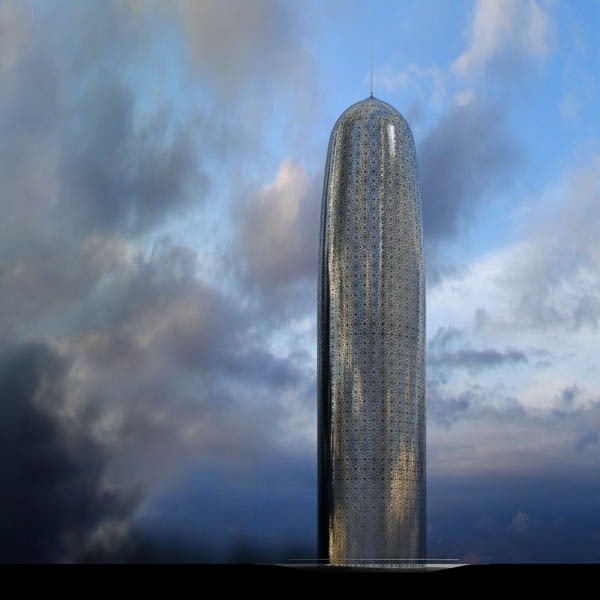
Doha 9 High Rise Office Tower, Qatar

Designed by French architect Jean Nouvel, the 231 meter tall building located between the north side of Doha Bay and the new city centre was heavily criticized in 2007 when the building was first proposed. An artist impression that appeared back then appeared to look like a huge shining sex toy.
The completed building looks beautiful and was also named the best tall building in the Middle East and Africa. But the early views have stuck making it impossible to see the building as anything else.

jean_nouvel_doha_tower_04
the-doha-tower

Velo Towers in Seoul

Velo Towers designed by New York-based Asymptote Architecture has been compared to both a toilet-roll holder and a cam shaft. The 153 meters tall twin towers is currently shaping up in Seoul, South Korea.
The two towers are connected by a skybridge which is suspended 30 storeys above ground level, providing the residents of both structures with fitness and recreation centres, communal lounges, pools, spas and eateries, as well as a landscaped sky garden. A raised plinth at ground level also offers communal facilities in a light-filled atrium.

velo-towers2
velo-towers

The Cloud, South Korea

Dutch architecture firm MVRDV proposed a design for two high-rises in Korea that reminds people of the World Trade Center twin towers exploding on 9/11.  A mockup shows two soaring skyscrapers connected in the middle by a “pixelated cloud” that evoked the clouds of debris that erupted from the iconic World Trade Center towers after terrorists flew planes into them.
The luxury residential towers have been named ‘The Cloud’, with one reaching 260 metres or 54 floors and the other covering 60 floors over 300 metres. The total surface area is 128,000 sq metres. The ‘cloud’ is housed in a 10-floor tall structure positioned halfway up the structures, and the towers feature a fitness studio, pools, restaurants, cafes and a conference centre.

wtc-exploding
wtc-exploding2
MVRDV later made an apology saying the that the resemblance was unintentional and that they didn’t see that way the design process. The future of the project is unclear.

Asahi Beer Headquarters

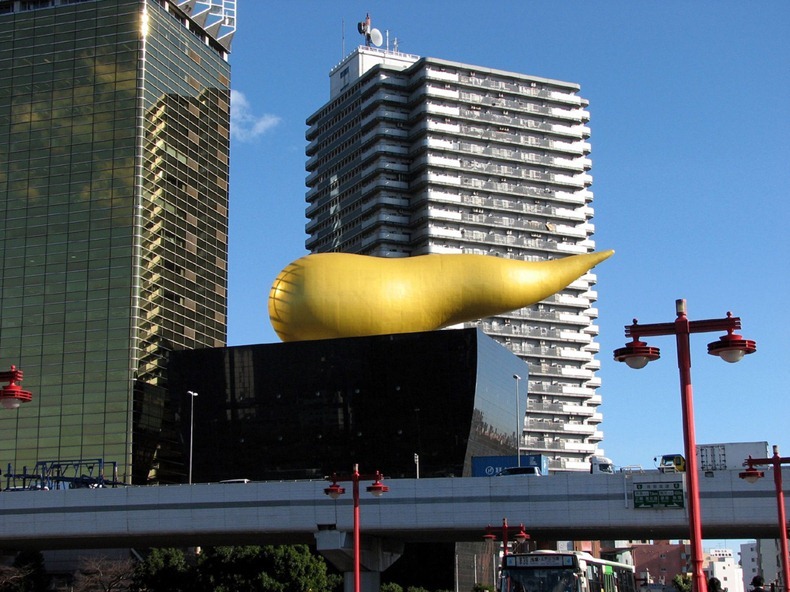
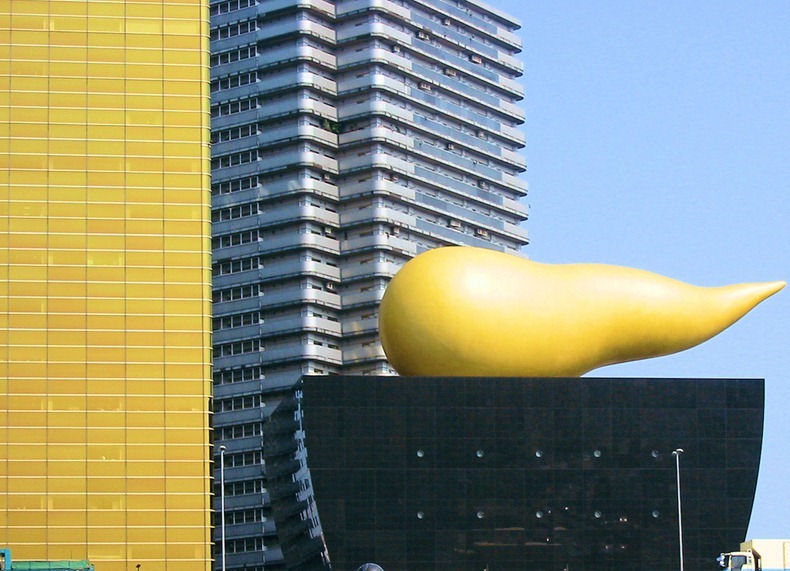
Asahi Beer Headquarters located on the east bank of the Sumida River in Sumida, Tokyo, Japan is considered one of Tokyo’s most recognizable modern structures. There are two main buildings, the biggest building standing 100 meters tall resembles a giant beer jug complete with a foam shaped white roof. The shorter building is known as the Super Dry Hall. It is a black building in the shape of a beer glass, with an enormous golden flame shaped object perched on top.
The golden structure at the top is said to represent both the ‘burning heart of Asahi beer’ and a frothy head, but the the structure is often colloquially referred to as “the golden turd” and the Asahi Beer Hall itself as “poo building”. Some people even see the flame’s similarity to the human sperm.

asahi-building
asahi-building2

Fighting Protesters With Colored Water

colored-water-weapon-10

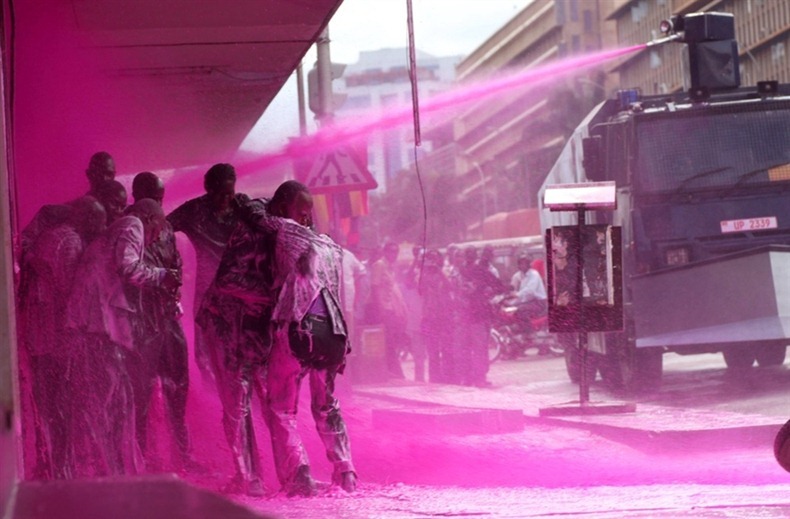
You must have seen photos of protesters being doused with colored-water cannons by the police. Using water canon is understood as it’s an easy non-hazardous way to disperse mob, but why would police spray protesters with purple and pink water? Simple: to identify and arrest them later. Many water cannons on the market today come with a tank specially designed to store a semi-permanent colored dye. If police decide they want to “tag” protesters with the dye, they can press a button to inject it into the main water stream. 

Once the water cannon is trained on a crowd, anyone hit by the spray will be easily recognizable by police.

The most famous use of colored-water cannons took place in South Africa in 1989, when police soaked anti-apartheid activists with purple water. But in the ensuing chaos, one of the protester turned a water cannon back at police and towards the local headquarters of the ruling National Party. The headquarters, along with the historic and white-painted Old Town House, were doused with purple. The next day, a graffiti artist tagged the Old Town House with the phrase “The Purple Shall Govern,” which soon became an anti-apartheid slogan.


Police spray Ugandan opposition party leaders with colored water during demonstrations in the capital Kampala, May 10, 2011. President Yoweri Museveni has vowed to crush the protests and blamed rising food and fuel costs on drought and global increases in oil prices. (James Akena / Reuters)

During the last 15 years, protesters in Hungary, Indonesia, Argentina, Malaysia, India and Israel have all been showered with colored water. In Uganda last year pink dye was employed to humiliate protesters. In Israel, Palestinian rioters were sprayed deep blue, the colour of the Israeli flag. The Hungarian police use green, the Koreans orange. Indian police is particularly fond of purple.

How to Reduce Your Chances of Getting the Flu


The flu is mostly a seasonal disease that is uncomfortable and highly contagious. There are ways you can protect yourself every year during flu season, and reading this article will teach you to reduce your risks for the flu.
Instructions
1-Consume a balanced and healthy diet. Eating right every day is key to a healthy immune system and having a healthy immune system is key warding off sicknesses such as the flu. If you don’t eat a well balanced and healthy diet, you are depriving your body of nutrients necessary for maintaining healthy immunity. Eat a diet rich in vegetables and nutrients.
2-Consider taking a multivitamin everyday. Multivitamins contain vitamins such as vitamin C for strengthening immune systems. Some foods contain many nutrients and some don’t contain enough, so even though you think you may be eating the right foods you may not be getting proper nutrition. Taking a multivitamin acts as a sidekick to any diet supplying you the nutrients that you need that you may not always get from the food that you eat on a daily basis. If you need help on selecting the right multivitamin or multivitamins geared towards healthy immunity, simply ask your doctor or pharmacist.
3-Consider getting a flu shot every year. In addition to maintaining a healthy diet, getting the flu shot every year can help you almost avoid getting the flu. When doctors administer the flu shot, they give you a weakened form of the virus so the body can become immune to the disease.

China Builds Road Around House Because Owner Refused to Move


In the eastern Chinese city of Wenling, a lone five-story row house with ragged edges stand in the middle of a motorway in staunch defiance. The house belongs to Luo Baogen, a duck farmer, and his wife who are the lone holdouts from a neighborhood that was demolished to make way for the main thoroughfare heading to a newly built railway station. Luo Baogen and his wife insist on living in the half-demolished building because they believe that the relocation compensation offered by the government is not enough. Dramatic images of Luo’s home have circulated widely online this week, becoming the latest symbol of resistance in the frequent, countrywide standoffs between homeowners and local officials accused of offering too little compensation to vacate neighborhoods for major redevelopment projects.


During most of the Communist era in China, private ownership of property was abolished, making it easy for residents to be moved. But now the laws have been tightened up and it is illegal to demolish property by force without an agreement. Property owners in China that refuse to move to make way for development are known as ‘Nail Householders’ referring to a stubborn nail that is not easy to remove from a piece of old wood and cannot be pulled out with a hammer.

Luo had just completed his house at a cost of about 600,000 yuan ($95,000) when the government first approached him with their standard offer of 220,000 ($35,000) to move out, which he refused. The offer has since gone up to 260,000 yuan ($41,000).
What is unusual in Luo’s case is that his house has been allowed to stand for so long. It is common for local authorities in China to take extreme measures, such as cutting off utilities or moving in to demolish when residents are out for the day. Luo told local reporters his electricity and water are still flowing, and that he and his wife sleep in separate parts of the home to deter any partial demolition.
Other families haven’t been so ‘lucky’. Earlier this year, Niu Chuangen and Zhang Zhongyun dared to stand in the way of a local property developer in Zaozhuang, in the Shandong province. As a result, the resolute couple, both in their 60s, have been left stranded on their tiny spot of land, while all around them the ground is dug up and skyscrapers erected. Their utilities were cut off, and the distraught pair were regularly threatened by gangsters and have had to fend over a number of attempts to illegally demolish their ramshackle home.
In another case, one family among 280 others at the site of a six storey shopping mall being built in Chongqing refused to leave their home for two years. Developers cut their power and water, and excavated a 10-meter deep pit around their home, which their family had inhabited for three generations.
The owners broke into the construction site, reoccupied it, and flew a Chinese flag on top and then Yang Wu, a local martial arts champion, used nunchakus to make a staircase to the house and threatened to beat any authorities who attempted to evict him. The owners turned down an offer of £300,000 but eventually settled with the developers in 2007.

house-middle-of-road-0
house-middle-of-road-1
house-middle-of-road-3
house-middle-of-road-4
house-middle-of-road-5
house-middle-of-road-6
house-middle-of-road-7

Inspiring New Vertical Farming Designs Bring Cities a Step Forward


Vertical farming is a method for growing crops in multistory buildings. Few consider it a bad idea, but the vertical farming industry continues to progress from an abstract dream to concrete designs, with engineering projects in Sweden and Canada bringing food closer to urban dwellers.

Farmlands may have turned into suburbs near cities, but sky farms allow urbanites to reconnect to their agricultural roots. Take architectural firm Plantagon, which has designed one such sky farm for Linkoping, Sweden.


Dubbed a “plantascraper”, the 17-story building conserves resources by recycling. Waste heat from a nearby electricity plant will warm the greenhouse, while carbon dioxide from the same source will promote photosynthesis and, consequently, crop growth. Compost from the suburbs will become inputs for the plantascraper and methane from the facility will power an electricity generator. Compared to farming on land, the sky farm will require less water, because it is nearly a closed-loop ecosystem.


Plantagon’s design for Linkoping’s sky farm incorporates a ramp that spirals up the spherical building and an automated system to move crops along as they grow. Plantagon also has plans for other vertical farms in different cities. Those planned range from five stories to twenty-five stories and are aimed at feeding populations ranging from 10,000 to 350,000. The capital costs per person for building Plantagon’s sky farms are low enough to make them feasible in many regions.


While bold new vertical farming projects could soon grace European cities, a more modest rooftop farm is under construction in North America. Alterrus Systems is building a vertical farm on the top level of a parking garage in Vancouver, Canada. The lack of manufacturing in Vancouver’s history makes it relatively suitable for urban farming, according to the executive behind the project. Taller buildings that neighbor the 

Alterrus garden will shield it from wind but still allow sufficient sunlight onto the plot.

Vancouver nonprofits already encourage small-scale urban farms in the area, but Alterrus Systems’s commercial farming venture seems to bring the city’s urban farming to a professional level. Once it is completed, Alterrus Systems will manage the 560-square meter vertical farm and sell produce from it through supermarkets. Christopher Ng, the CEO of Alterrus Systems, picked the top of a parking garage for growing crops, because a decline in car use leaves many garages underutilized.


If Vancouver’s new vertical farm becomes successful, it could pave the way for other moderately dense urban areas to transition towards a less car-dependent lifestyle. It seems possible that low-density suburban areas can become high-density suburban areas with parkades and from there be turned into urban areas with vertical farms. This steady grow would suit some places nicely.

Building a multistory greenhouse at the start may be a better strategy for other locations. After all, each region has its unique characteristics – but with so many designs available, builders can surely pick a plan to match any given neighborhood.

Marriage Mistakes Women Make


For some women, the transition from exciting dates to marriage is inexplicably difficult. Although, marriage can spurt adjustments and difficulties, silly mistakes can weaken the foundation of your relationship. Here are some common marriage mistakes that women make. Remember that little positive actions can win a great deal of good.

Insecurity towards other Women
A common marriage mistake women make is being constantly threatened by the other women. Don’t be jealous of the other women around your man. Remember that your husband has chosen you as a life partner. Therefore, it is wise to focus on energies that will keep his eyes on you rather than be insecure. Negative and insecure thoughts can give birth to an unnecesary sense of helplessness and anger.


Being too emotional
Mostly, men resolve their problems analytically while women give preference to their emotions. Don’t let your emotions dictate you and control every bit of your action/s.

Withholding sex to ‘teach him a lesson’
Some women use ‘sex’ as a tool of punishment; this is not the right thing to be done. Sex is the most intimate part of marriage; whoever uses sex as a way to control the other partner does not value the relationsip as much as he or she should. If you have any point of difference with your partner, sit together and sort the problem by discussing about it.


Being over Accommodating
“Post marriage, some women become over-accomodating and are ready to give up their wishes”, says a Denver-based clinical psychologist; however, what women don’t realise is that by being over accommodating, they are not becoming a part of the marriage, but an accessory.

Complaining, Nagging and Criticizing
Complaining, nagging and criticising fell under the most commonly given answers that men gave when asked what their wives do that bothers them. Hence, don’t make these mistakes; remember that love is not about owning someone entirely. You have to accept his choices and move ahead. No one likes being criticised and torn apart.


Trying to Control Him
Another common complaint by married men is that their wife tries to control them. This is the biggest marriage mistake that women make. Every individual is a master of his/her own will and men are not an exception to this fact.